Crossing Borders: The Vietnam to Laos Motorbike Paperwork Guide


The riding is the easy part. Every year, riders plan a Vietnam Laos border motorbike tour, get as far as the checkpoint, and are turned back — not because of anything they did wrong on the road, but because of a document they did not know they needed.
This guide covers what customs and immigration actually ask for at the Vietnam–Laos crossings, which borders accept motorcycles at all, and where the rules differ depending on whether the bike is yours, rented, or supplied by an operator. It is the least glamorous part of an Indochina trip and the part most likely to end it early.
Before you read on. Border rules in this region change with little notice and are applied differently at different crossings. Everything below reflects standard practice, but confirm current requirements with your operator or the relevant embassy close to your departure date — never assume a blog post, including this one, is current.
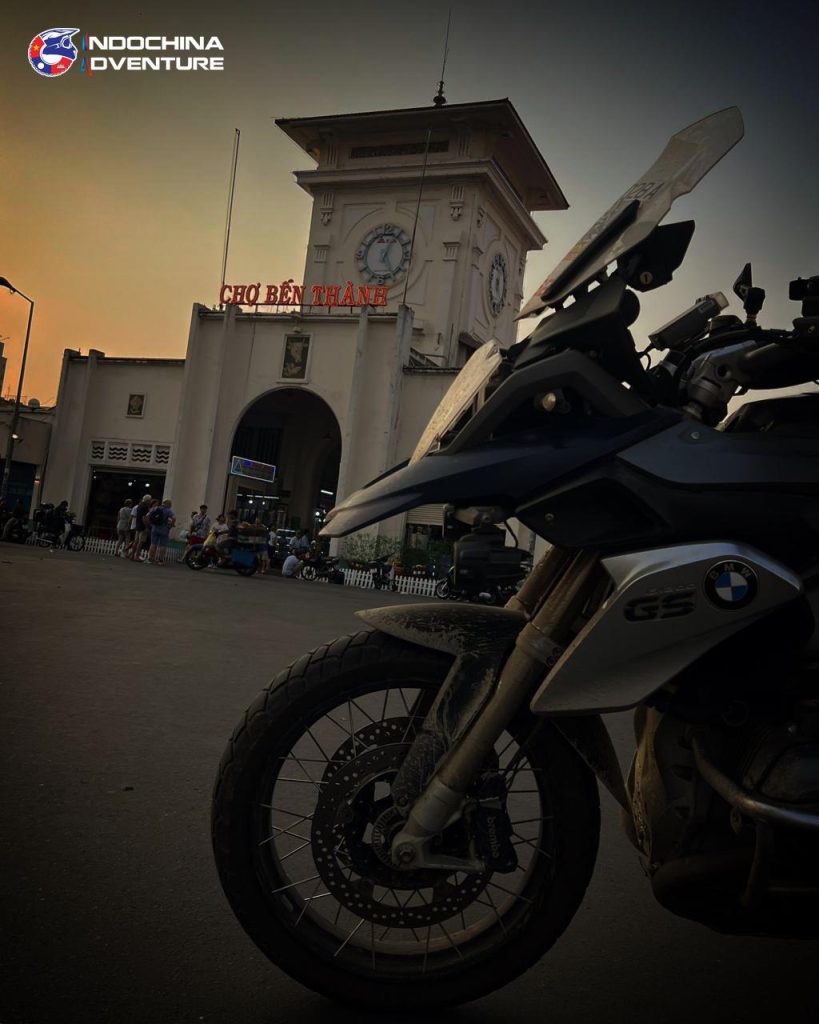
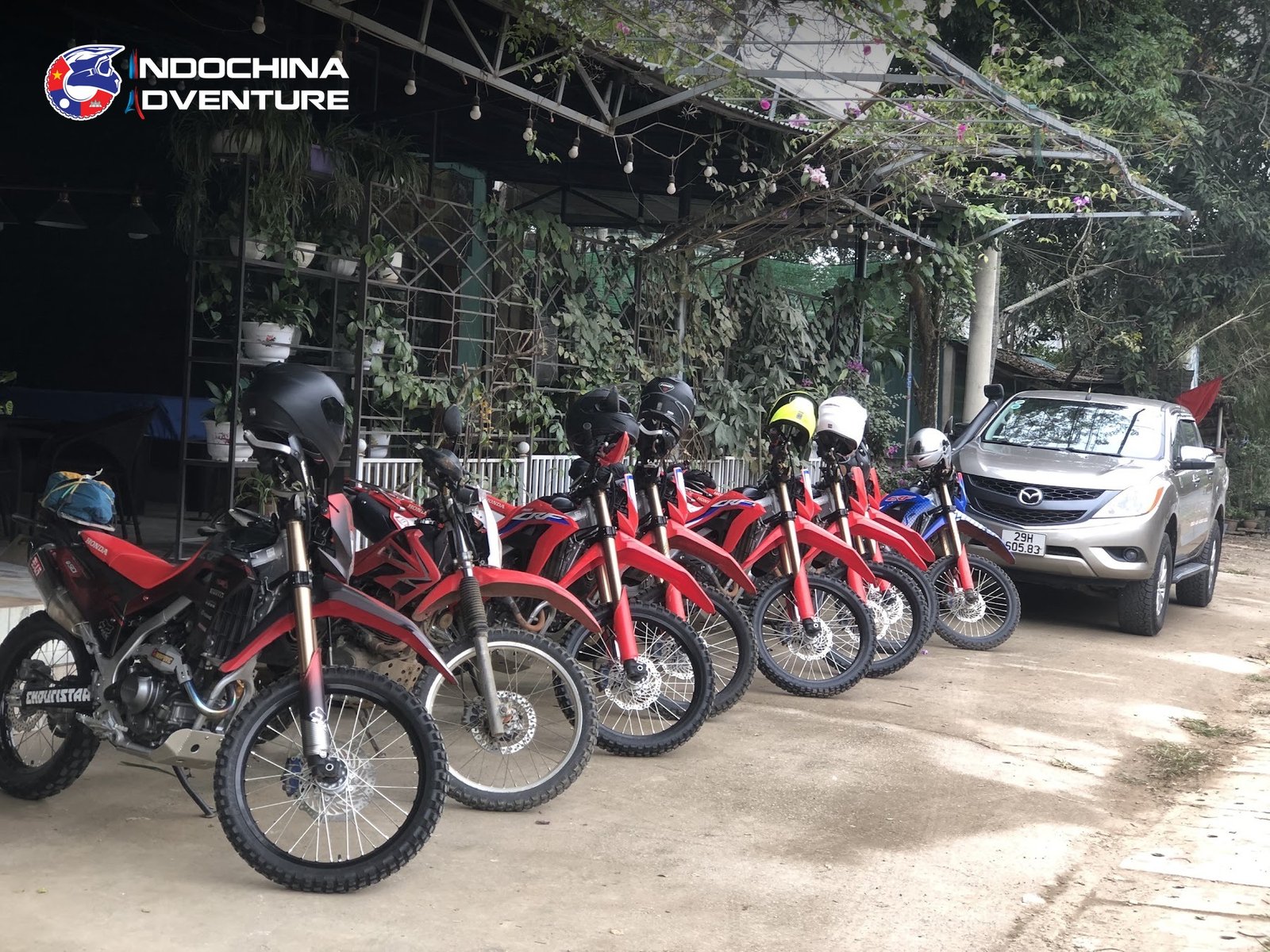
Most cross-border runs start a long way from the border — the paperwork has to be right before the bike leaves Ho Chi Minh City
The three documents that decide a Vietnam Laos border motorbike tour
Almost every rejected crossing traces back to one of these three.
1. Your visa for Laos
Most nationalities can obtain a Laos visa on arrival at international land borders, and many can now use the official Lao eVisa service. The complication for riders is that not every land crossing issues visas on arrival — arriving at a border that does not, without a visa already in your passport, means a long ride back.
If you are using the eVisa, check it lists the specific crossing you intend to use. They are issued for named entry points.
2. Your driving entitlement
You need a motorcycle licence from your home country plus an International Driving Permit issued under the 1968 Vienna Convention. The 1949 Geneva version, which some countries still issue, is not recognised in Vietnam.
This is checked far more often on the Laos side than the Vietnamese side, and it is what your insurance depends on regardless of whether anyone asks. Our guide to the motorbike licence in Vietnam for foreigners covers how to get the right one.
3. The vehicle’s papers
This is the one that stops most people, and the requirement is simple to state and hard to satisfy: you must be able to prove you are entitled to take that specific motorcycle out of Vietnam.
What that means in practice depends entirely on how you got the bike.
Owned, rented or supplied: three very different situations
| Your situation | What you need | Realistic difficulty |
| Bike registered in your name in Vietnam | Blue card (registration), plus a temporary export/import document for the vehicle | Workable, but the paperwork takes time to arrange in advance |
| Rented from a shop | Written authorisation from the registered owner, usually notarised, plus the blue card or a certified copy | Most rental shops will not permit border crossings at all |
| Supplied by a tour operator | Handled by the operator as part of the tour | Straightforward — this is why most cross-border riders go guided |
The middle row is where trips fall apart. A standard rental agreement in Hanoi almost never includes permission to leave the country, and turning up at the border with a bike you cannot prove you are allowed to export is the single most common reason riders are refused.
Which crossings a Vietnam Laos border motorbike tour can use
Vietnam and Laos share a long border with many crossings, but only the international gates can process foreign nationals and foreign-registered vehicles. The ones most used by riders, whether the plan is northern Laos or the south of the country:
| Crossing | Vietnam side | Laos side | Useful for |
| Tay Trang | Dien Bien Phu | Muang Khua | Northern loops joining Sapa or Ha Giang to north Laos |
| Nam Can | Nghe An | Nong Haet | Central route towards the Plain of Jars |
| Cau Treo | Ha Tinh | Nam Phao | The most direct link to Vientiane |
| Cha Lo | Quang Binh | Na Phao | Joining Phong Nha to the Thakhek Loop |
| Lao Bao | Quang Tri | Dansavanh | The busiest gate, best for southern Laos |
Smaller local crossings exist and are open to Vietnamese and Lao citizens only. Riding to one of these because it looks closer on the map is a wasted day.
What actually happens at the border
The process is slower than it sounds and runs in a fixed order:
- Vietnamese exit immigration — passport stamped out.
- Vietnamese customs — vehicle documents checked and the bike recorded as leaving.
- A no-man’s-land stretch of a few hundred metres to several kilometres.
- Lao immigration — visa on arrival issued here if applicable, or eVisa verified.
- Lao customs — temporary import of the vehicle, and a fee.
Allow two to three hours for a straightforward crossing and half a day if anything is queried. Most gates close in the evening, and some close for a long lunch — arriving at 4pm on a Friday is how riders end up sleeping in a border town.
Vietnam Laos border motorbike tour insurance: the part nobody checks
Vietnamese motorcycle insurance does not extend into Laos. Third-party cover is normally purchased at the border for a small fee, and it is worth having even though enforcement is minimal.
Far more important is your personal travel and medical insurance. Verify three things specifically: that it covers motorcycling, that it covers your engine size, and that it includes emergency evacuation. Serious injuries in Laos are treated in Thailand, and an evacuation without cover is extremely expensive.
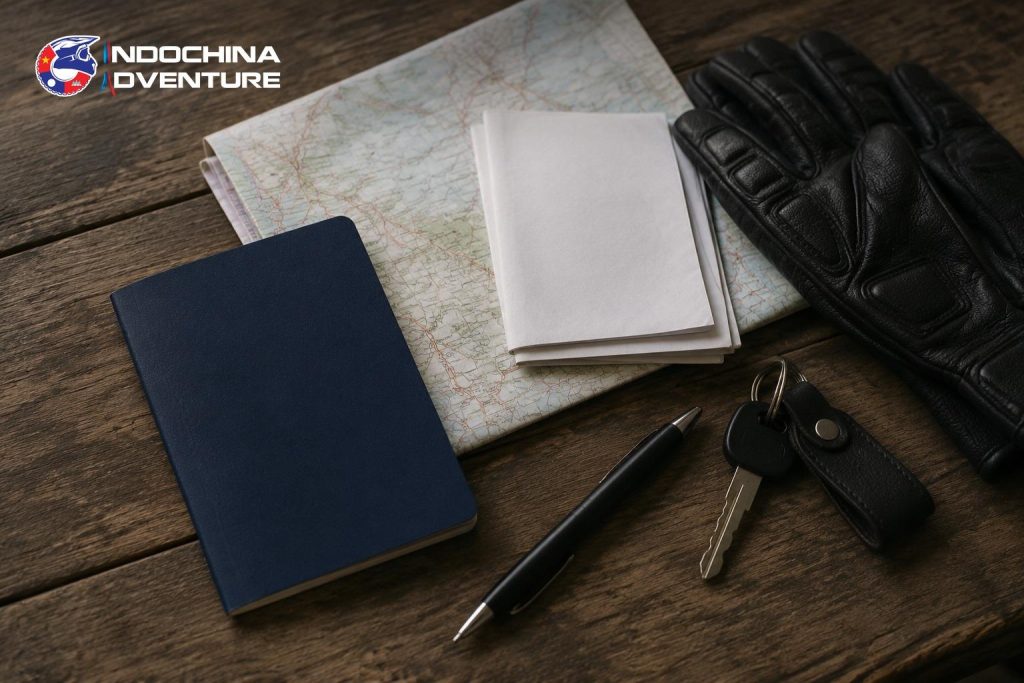
Passport, IDP, vehicle registration and written authorisation — the four documents worth photographing before you set off
Practical advice that saves a Vietnam Laos border motorbike tour
- Photograph every document and store copies offline and in cloud storage. Officials will accept a photo of a blue card far more readily than nothing at all.
- Carry small US dollars. Visa and customs fees are often payable in cash, and change for large notes is not guaranteed.
- Cross in the morning. It leaves the day to solve problems, and gets you to somewhere worth staying on the far side.
- Avoid public holidays in either country. Queues multiply and staffing drops.
- Match your exit gate to your visa if you are using an eVisa — it names the crossing.
- Know your re-entry plan. If you intend to return to Vietnam, check whether your Vietnamese visa is single or multiple entry before you leave.
The single-entry trap. Riders on a single-entry Vietnamese visa who cross into Laos cannot ride back in. This is a surprisingly common and completely avoidable end to a trip — check the entry type on your visa, not just the expiry date.
Why most riders book a guided Vietnam Laos border motorbike tour
None of the above is impossible independently. It is simply slow, and the failure modes are severe: a missing authorisation letter costs you the border, and a single-entry visa costs you the return leg.
On a guided Vietnam Laos border motorbike tour, the vehicle documentation, temporary export and import, border insurance and crossing logistics are handled before you arrive at the gate. The bikes are already documented for international travel, which is the part an individual traveller cannot easily replicate. If you would rather ride than queue, that is what you are paying for — see how the crossings fit into our Vietnam motorbike tours and Laos motorbike tours, and what the tour prices cover.
Vietnam Laos border motorbike tour: frequently asked questions
Can I take a rented Vietnamese motorbike into Laos?
Only with written, usually notarised, authorisation from the registered owner plus the registration document. Most rental agreements explicitly forbid it, so ask before you rent rather than at the border.
Can I get a Laos visa on arrival at the border?
At the international gates, most nationalities can. Confirm your own nationality’s status and confirm the specific crossing issues them, because not all do.
How long does the crossing take?
Two to three hours when everything is in order. Our guide to the best routes through north and south Laos covers what is on the other side. Half a day or more if a document is queried. Gates also close in the evening and some pause at midday.
Do I need an International Driving Permit?
Yes — the 1968 Vienna Convention version. Enforcement varies, but your insurance almost certainly depends on it whether or not anyone at the border asks.
What happens if I am refused entry with the bike?
You ride back. There is no appeal at the gate. This is why the vehicle paperwork should be settled well before you approach the border.
Can I leave the bike in Laos and fly home?
No. A vehicle temporarily imported must be taken back out, and failing to do so creates problems for whoever the bike is registered to.
Is the same paperwork needed for Cambodia?
The principle is the same — visa, driving entitlement, vehicle authorisation — but the specific requirements and accepted crossings differ. Do not assume Laos preparation covers a Cambodian crossing.
An Indochina crossing is one of the great rides in Southeast Asia, and the border is the only genuinely difficult part of it. Get the three documents right — visa, licence, vehicle authorisation — and the rest is a morning of queuing followed by some of the emptiest roads you will ever ride. Tell us where you want to cross and the Indochina Adventure team will take the paperwork side of it off you.


Latest posts
Cao Bang to Ha Giang Motorbike Route: Northern Vietnam Loop Guide
 Date: 20/09/2026

Cambodia Adventure Motorbike Tour: Angkor and Beyond
Date: 18/09/2026
Crossing Borders: The Vietnam to Laos Motorbike Paperwork Guide
Date: 16/09/2026
Bigbike vs Dirtbike Tours in Vietnam: Which One Should You Book?
Date: 12/09/2026

Laos Motorbike Tour: The Best Routes Through North and South Laos
Date: 10/09/2026
Maybe You Don’t Know
Cao Bang to Ha Giang Motorbike Route: Northern Vietnam Loop Guide
The Cao Bang to Ha Giang motorbike route as one 8-day loop: stages, distances, real…
Date: 20/09/2026

Cambodia Adventure Motorbike Tour: Angkor and Beyond
A Cambodia motorbike tour guide: Angkor, the temples beyond the park, the red dirt northern…
Date: 18/09/2026
Ninh Binh by Motorbike: Tam Coc, Trang An and the Roads Most People Miss
A Ninh Binh motorbike tour guide: the Tam Coc and Trang An loop, the quiet…
Date: 14/09/2026
Bigbike vs Dirtbike Tours in Vietnam: Which One Should You Book?
Bigbike vs dirtbike tour Vietnam: an honest comparison of terrain, riding demand, comfort and cost…
Date: 12/09/2026
Laos Motorbike Tour: The Best Routes Through North and South Laos
A Laos motorbike tour guide covering the northern mountain loops and the southern Thakhek and…
Date: 10/09/2026
South-North Vietnam Offroad Motorbike Tour: Riding HCM City to Hanoi The Hard Way
Planning a Vietnam offroad motorbike tour from HCM City to Hanoi? Route breakdown, daily distances,…
Date: 08/09/2026